


Most teams don’t fail because they can’t build – they fail because they build the wrong thing too early. The confusion between Prototype, PoC, and MVP is a big part of that. These terms get thrown around loosely, often used interchangeably, which hides a more serious issue or issues to arise as a team moves to the next stages of product development. Each of these is meant to answer a completely different set of questions and be used at different stages during development. Sometimes, not even to be used at all.
When that distinction is ignored, teams end up validating the wrong assumptions. They might prove users like a design without knowing if the tech works, or worse, build a full product before confirming anyone actually wants it. The result is predictable, wasted budget, delayed timelines, and products that never gain traction.
In this article, we will explain how using the right tool at the right time can remove the related risks.
Prototype
A prototype exists to answer one thing: Does this make sense to users, does it solve their problem?
Prototypes in most of the cases, surround that main question with other sub-questions related to the different aspects of the prototype: functionality, usability, use/edge cases, etc. It’s not about building functionality. It’s about simulating the experience. You’re testing how users think, how they navigate, and whether the idea is even understandable. At this stage, speed matters more than accuracy. The goal is to learn fast and change faster. A good prototype is disposable. If you get attached to it, you’re doing it wrong.
Teams should use prototypes when the biggest uncertainty is around usability or product direction. If users don’t understand what they’re looking at, it doesn’t matter how well it’s engineered later. The cost is low because you’re not writing production code. But the impact is high, in terms of catching UX flaws early and far cheaper than fixing them after launch.
Example: Palm Pilot
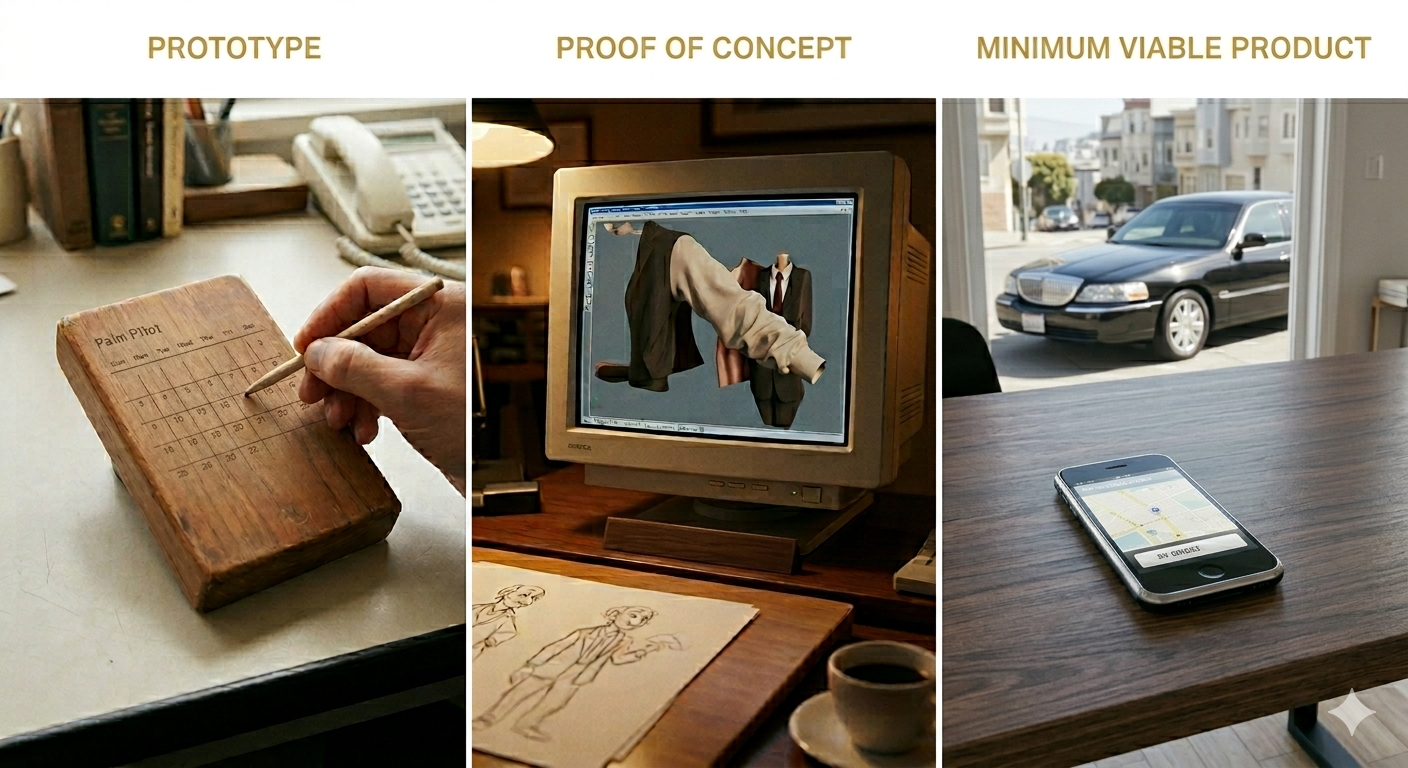
Jeff Hawkins, the founder of Palm Computing, carried a carved block of wood in his pocket for weeks. He would pull it out and pretend to take notes or check his calendar with a small stick. He wasn’t testing tech or market demand; he was testing the form factor and habit. He wanted to see if the “user experience” of a handheld device actually fit into a daily routine before a single circuit was soldered. The result, was a valuable set of data and features of how the Palm Pilot device will be used or look like.
PoC (Proof of Concept)
A PoC answers a different question: Can this actually work, can we even build it?
This is where technical reality kicks in. You’re not concerned with polish or user experience, you’re testing whether the underlying idea is technologically feasible as well as if it is economically viable (not too costly and time consuming to build). This is especially critical when dealing with new or uncertain technology, like AI, integrations, or performance-heavy systems.
PoCs are often messy, quick, and built with one purpose: validation. If it fails, that’s a success and you’ve just avoided building something impossible. Teams should prioritize a PoC when the biggest risk is technical. If you’re unsure whether something can be built reliably, there’s no point designing or launching it yet.
The cost sits in the middle. It requires engineering time, but it’s still far cheaper than committing to a full product.
Example: Pixar short films.
Pixar using short films to test specific animation techniques, like cloth physics in Geri’s GamePixar’s “short film” strategy is a masterclass in the technical PoC, where they isolate a singular, high-risk animation challenge like the complex cloth simulation in Geri’s Game or the fluid dynamics of water for Finding Nemo to prove its viability before committing to a multimillion-dollar feature. By treating these shorts as experimental sandboxes, they ensure that by the time a full-length production begins, the “impossible” tech has already been de-risked and refined in a controlled, low-stakes environment.
MVP (Minimum Viable Product)
An MVP answers the most expensive question: Will people actually use or pay for this?
This is no longer a simulation or an experiment in isolation. It’s a real product, in the hands of real users, solving a real problem just with minimal features. The goal is not perfection, but validation at the market level. At this stage, assumptions become measurable. You’re looking at user behavior, retention, and willingness to engage or pay. Unlike prototypes or PoCs, an MVP carries real consequences because it involves real users and in many cases on a much bigger scale.
That’s why it’s the most expensive step. You’re building production-ready systems, handling edge cases, and supporting actual usage. At this stage, teams might use expensive, out of the box plug and play systems, higher end materials, etc. This is mainly because of the speed to deliver is more important than actually building and establishing pipelines. A hardware product might use off-the-shelf electronics that simply needs to be plugged in. At later stages, once the MVP proves to be the right solution, the companies move to full production with much cheaper electronics.
Example: Uber
The early version of UberCab in San Francisco is the definitive MVP because it moved beyond simulation to facilitate a real-world financial transaction with immediate consequences. Rather than building a global, automated logistics engine, the founders launched with just three cars and a basic app to solve the specific problem of booking a black car in one city. By focusing on this functional service, they used real payment data to prove market demand was viable before investing in the massive technical infrastructure that defines the platform today.
Common Mistakes
The biggest mistake is not choosing the wrong tool (Prototype, PoC, MVP), it’s not knowing what you’re choosing at all.
Teams build MVPs when they should be testing feasibility with a PoC. Others over-invest in prototypes, polishing designs that were never technically viable. Some skip prototyping entirely and assume users will “figure it out,” only to discover usability issues after launch.
Another common issue is treating these stages as a strict sequence. They’re not. The order depends entirely on where the biggest uncertainty lies. If the tech is risky, start with a PoC. If the UX is unclear, start with a prototype. If both are known, move toward an MVP.
When to Use Them
Whether you should use all these tools depends entirely on the specific risks your team needs to mitigate; they are not mandatory chronological stages, but rather targeted filters for uncertainty.
- Prototype: Use this when the primary risk is usability, allowing you to simulate the user experience and test if the solution is intuitive before writing a single line of code.
- Proof of Concept (PoC): Deploy this when the primary risk is feasibility, focusing strictly on whether a specific technical or economic hurdle can be cleared.
- Minimum Viable Product (MVP): Implement this when the primary risk is market demand, putting a functional, no-frills version into the hands of real customers to see if they will actually use or pay for it.
Final Thoughts
In this article, we touched upon the differences between Prototype, PoC, and MVP. They are not stages, rather filters for different types of risk. Each one exists to answer specific set of questions, and skipping or misusing them means carrying that uncertainty forward. The real question isn’t what to build first. It’s what you don’t know yet and how cheaply you can find out. This article does not cover these tools in depth, but it serves as a reality check to ensure you are building the right thing by understanding the mechanical differences between a PoC, a Prototype, and an MVP.

Veselin Tenekedzhiev is a Product Development Specialist, Co-Founder of Atlantis EdTech, and Owner of Different Way Games based in Dubai, UAE. With over 14 years of experience, he has delivered web, mobile, desktop, and interactive products across multiple industries.
Combining expertise in software development, product strategy, cloud technologies, game development, and interaction design, he helps organisations turn ideas into successful digital products by leading workshops, defining product direction, and guiding projects from concept to launch.
He holds a BSc in Software Engineering, a Master’s in Interaction Design and Technologies, and an MBA in Technology Management.