


Intro
Did you know that according to the EU Industrial R&D Investment Scoreboard 2025, the world’s top 100 companies invested about $805 billion in R&D in FY2024. alone? Yet, those investments don’t always lead to breakthrough innovations. How is that possible? The answer – many of these firms follow well-established processes, like Six Sigma and if you come from a design background, you know the usual steps: define user needs, gather data on inefficiencies or potential improvements, build, test, analyze, and iterate. But here’s the reality: invention is naturally disorderly. Many innovations we use today happened either by accident or weren’t planned. The key lies in recognizing opportunities when they arise – R&D and design can’t always be forced within the walls of a company headquarters.
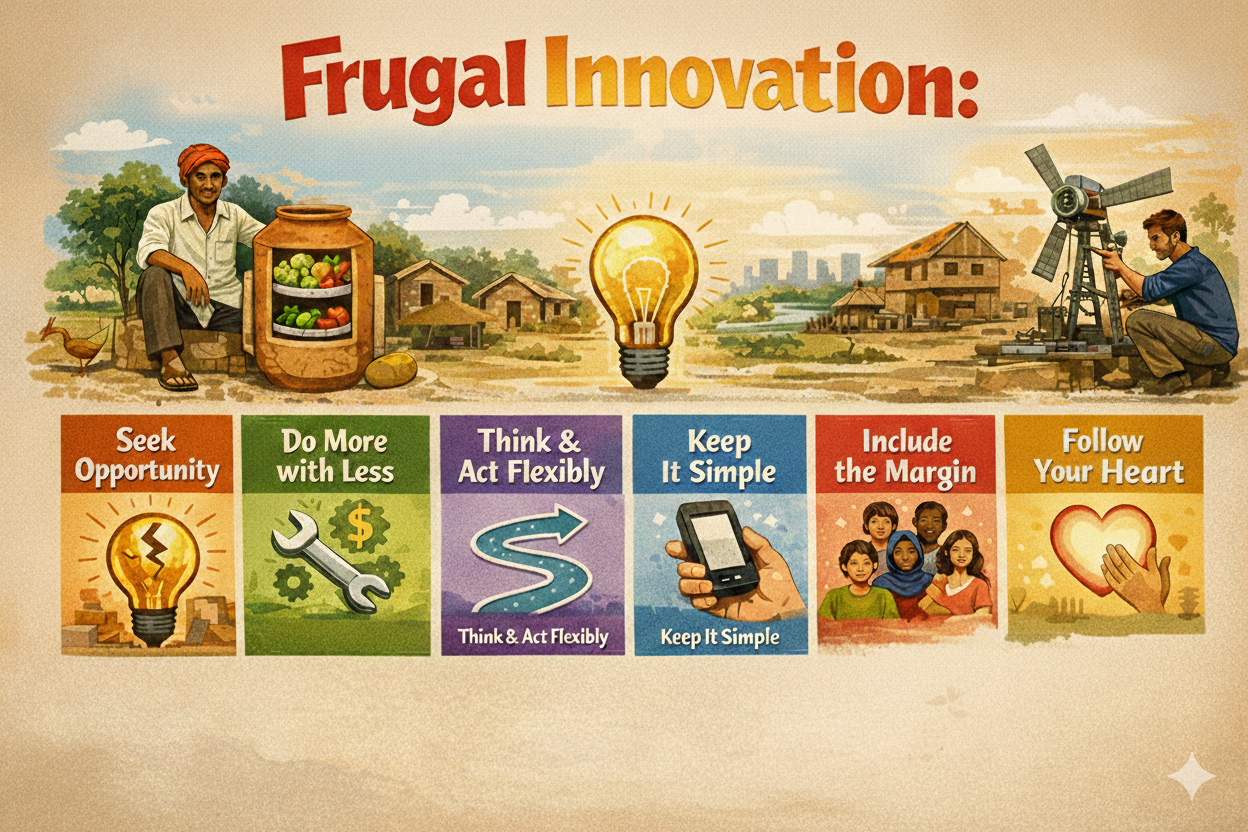
Meanwhile, in developing countries like India, someone (M.R. Prajapati), from a rural village, invented a clay fridge that requires no electricity and is fully bio-degradable. There is a trending shift, which is at the same time old as the world of innovators – called Frugal Innovation. You might know it as DIY (Do It Yourself), or, in India, Jugaad – meaning a clever solution to a problem, using available resources or working within severe constraints.
In fact, the principles of such product design have always existed, however in the past 20 years, that mind-set in business, design schools, and company processes has been largely forgotten, replaced by the methods we know today as Six Sigma.
What is Frugal Innovation?
Frugal innovation is about creating effective solutions with minimal resources by prioritizing core functionality and cost efficiency. It emerges from constraints, not abundance and is driven by necessity rather than a sense of power or unlimited resources, which big corporations have. When teams are forced to work within tight limits, they focus on essentials, which often leads to simpler, more original, and more resilient breakthroughs.
Components of complexity
The components of complexity – scarcity, diversity, interconnectivity, velocity, and breakneck globalization, all shape the environment in which frugal innovation thrives, creating both challenges and opportunities for creative problem-solving.
- Scarcity – we live in a world of limited resources, where products, housing, education, and healthcare are becoming increasingly unaffordable. Gen Y and Z are adapting to learn how to survive and thrive in this environment. As a result, new ways of doing things and leading our lives will emerge in the future.
- Diversity – teams are not only generationally diverse but also multicultural, requiring collaboration toward common goals despite differing values and beliefs.
- Interconnectivity – the internet, cloud services, and social media create new ways to do business, work on side projects, and connect with clients and audiences
- Velocity – companies must deliver products and features quickly to satisfy customers while staying ahead of trends and market changes, reacting even faster to unexpected shifts.
- Globalization – emerging markets are growing in population, skills, and knowledge, increasing competition and demanding more energy and innovation in the years ahead.
How Innovators Can Start Today
Big corporations with billions in budgets and R&D teams make us believe that true innovation can only happen that way. Yet, great inventions have also been made at home, some even by pure accident. Here we also need to distinguish between Invention and Innovation. Invention is simply something new (a system, technology, etc.) that doesn’t necessarily solve a problem but brings new insights into the world or unlocks new abilities. Innovation is taking such an invention and using it to solve a specific problem.
Below are two examples of how some innovations came to be.
- Post-it Notes (3M, USA) – the adhesive already existed as an invention, but failed its original purpose because it was too weak. Innovation occurred when 3M realized the same property was ideal for reusable notes, turning a failed invention into a new use-case.
- Microwave Oven (USA) – radar technology and magnetrons already existed for military use. Innovation happened when Percy Spencer applied this existing technology to cooking, creating a consumer appliance rather than inventing a new physical principle.
Practical Steps on Frugal Innovation
By applying the six principles of the Jugaad mind-set, we can take practical steps to create innovation within any constraints. As product developers, it is crucial to change the way we see and think about solving problems. By practicing the principles below, one would be better equiped in problem solving and bringing innovation.
- Seek opportunity in adversity
- Turn negatives into positives. Innovators learn to see challenges as openings for creative solutions rather than obstacles. When faced with difficult conditions, the key is to repurpose what seems like a problem into a resource.
- Example: if village roads are bumpy, the shocks from those stresses can be harnessed to generate energy, transforming a difficulty into a functional advantage.
- Do more with less
- Work with whatever resources are available—no angel investment, no large engineering teams, and limited energy or materials. The focus is on resourcefulness: reusing parts, minimizing costs, and finding inventive ways to achieve goals efficiently.
- Example: in Africa, mobile networks originally designed for communication are repurposed for banking and healthcare services via SMS and voice, providing essential services at very low cost, sometimes even faster than modern cloud solutions.
- Think and act flexibly
- Avoid being restricted by formal processes, step-by-step guides, or rigid business plans. True innovators adapt as they go, experimenting and adjusting solutions along the way. This flexibility allows them to stay ahead of unpredictable changes and respond rapidly to new challenges.
- Example: in areas with heavy traffic and poor roads, remote healthcare checks offer vital services for people unable to travel, bringing solutions to those who would otherwise be excluded.
- Keep it simple
- Solutions don’t need to be perfect—they need to solve the problem effectively while allowing for continuous improvement. Simplicity ensures accessibility and usability for the widest audience, while iteration refines the product over time.
- Example: OXO’s simple, user-friendly products, like liquid measuring cups readable from the top without lifting, make everyday tasks easier for a broad range of users.
- Include the margin
- Seek out underserved markets, overlooked demographics, or even people who aren’t direct consumers of the product. By addressing these gaps, innovations can have a broader social and market impact.
- Example: technology designed for people with disabilities or features catering to older generations not only serves these groups but also expands market reach and societal benefit.
- Follow your heart
- Don’t rely solely on data, charts, expensive tests, or focus groups. True insight comes from observing, connecting, and personally experiencing the needs of those who will use the solution.
- Simple conversations, close observation, and direct involvement often lead to the most practical and meaningful innovations.
Conclusion
We as product developers should not be limited to or advocate for a single method of research, design, or innovation. Instead, we should build a toolbox of diverse methods and approaches to support us in our journey to create something remarkable. This is why the principles of Frugal Innovation can be a valuable addition to any product design toolbox.
Reference: Radjou, Navi, Jaideep Prabhu, and Simone Ahuja. Jugaad Innovation: Think Frugal, Be Flexible, Generate Breakthrough Growth. Jossey-Bass, John Wiley & Sons, 2012
Veselin Tenekedzhiev is a Product Development Specialist, Co-Founder of Atlantis EdTech, and Owner of Different Way Games based in Dubai, UAE. With over 14 years of experience, he has delivered web, mobile, desktop, and interactive products across multiple industries.
Combining expertise in software development, product strategy, cloud technologies, game development, and interaction design, he helps organisations turn ideas into successful digital products by leading workshops, defining product direction, and guiding projects from concept to launch.
He holds a BSc in Software Engineering, a Master’s in Interaction Design and Technologies, and an MBA in Technology Management.