


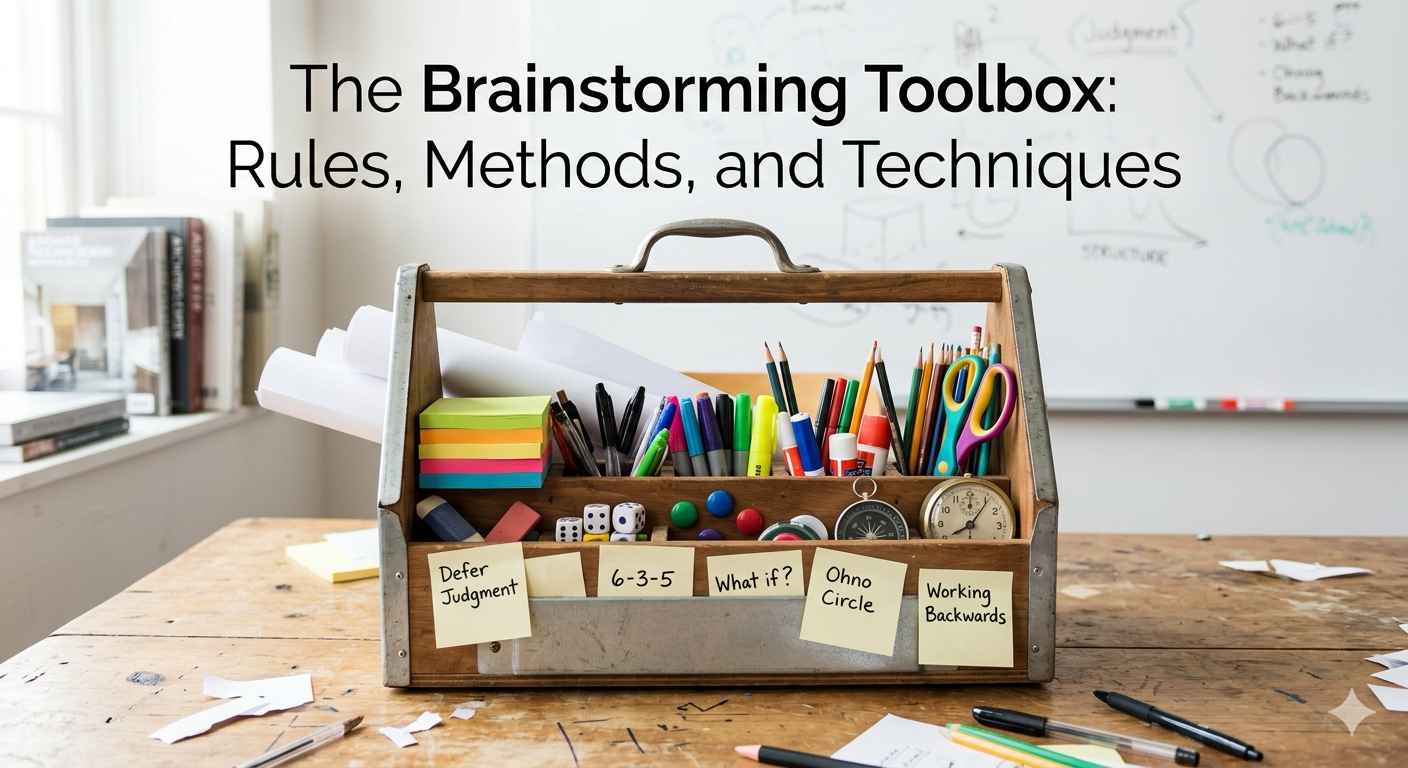
Have you been to a session where the team is tasked to brainstorm possible solutions to a problem or to just give ideas?
Those conversations often feel like a coffee chat about many things, even beyond the topic, only for the team to slap 5-10 obvious ideas together at the end and call it a day.
You would definitely have had a good time, and hey, you came up with something in the end, right? Right? Well, maybe to a point.
When done well, brainstorming sessions and the ideas they produce can be of tremendous value to you and your team, even putting you way ahead of your competitors in the market.
But what is a good and practical way to brainstorm and get the most out of it? Sit back and read on…
What is Brainstorming?
It is a session involving a group of people spontaneously generating ideas in response to a specific question or problem at hand.
The term comes from the participants in Alex Osborn’s organized marketing ideation sessions. Later his participants named it as “brainstorm sessions,” from the phrase: use “the brain to storm a problem.” The goal is to generate a vast pool of ideas for a specific problem.
Why is it used? Why is it good to follow?
The first solution that comes to mind might work, or it might be a waste of time and resources to implement later on.
Imagine a software developer who spends valuable time implementing a quick algorithm, only to discover later that the solution falls short and another approach would have worked better. However, even that second solution might not be the right one either. What if there was an even better one?
Implementing each of these is not the right approach, since it will be time consuming. Brainstorming comes to the rescue, allowing teams to generate ideas up-front before deciding on the best direction, which saves time in the long run and provides the most optimal and creative solution.
The Brainstorming Process
- Choose a facilitator: this is very important, since there must be a person who makes sure of the following:
- The conversation goes on
- Everyone participates
- Everyone follows the rules of brainstorming
- Encourages others
- Reminds participants if they drift away from the topic
- In some sessions, writes down or sorts ideas as they come
- Minds the time
- Define a brainstorming question: this is the question you are trying to solve.
- Examples:
- How can we make our existing customers spread the word about our product?
- What features could make customers stay long-term with our product?
- Constraints* examples to place around the question:
- Customers in USA
- Female users only
- Mid-to-high income families
- The question should be short, clear, and to the point. Additional clarifications can be written below it under a “Constraints*” section. These should be clarified up-front so the team is focused on the solution. Note: the constraints are there to help, but they should not be 100% followed at all times, mainly because this might defeat the purpose of the brainstorming. Brainstorming is mostly about letting the mind be free of constraints in general, so discuss this with your team; if they feel they need them to focus, be flexible about not following them strictly. It is usually a time-boxed session during which a large quantity of ideas is generated.
- Examples:
- Gather a small team (3-5 maximum): the larger the group, the more difficult it is to move quickly and get everyone heard. The sessions tend to be very dynamic with many ideas generated per minute. Smaller teams usually outperform bigger groups because everyone is actively participating and not waiting too long for their turn.
- Prepare materials:
- Whiteboard
- Post-it notes
- Colored pens
- Timer
- White paper
- Web browser (we recommend this since it is very useful to show a visual image, website, or video to others to articulate your idea. In our sessions, we also use it for inspiration)
- Ideate: there are different methods to brainstorm, which we have listed in this article. Two of those can be applied to a session like this one – you can use either the Rapid Ideation, 6-3-5 Brainstorming or other. There are many methods to brainstorm which are suitable for different situations. Here we have listed ones, which are quick to pick up and start right away.
- Ideas Sorting: at the end of the session, sort the ideas, discuss them, and combine them.
- Voting: (every member puts a vote on the ideas they like). The votes can be a certain number of points available for each participant. Usually, every participants can use their vote points on any idea, by placing a vote point around the idea note. If a participant is not fond of an idea, should not put a vote on it. Alternatively, through discussion, everyone agrees on which ideas they like already.
- Pick 3 ideas: one to go for and two backups in case the first chosen idea doesn’t work. At this point, we also recommend that you research online what already exists so that you aren’t surprised that the cool idea you thought nobody came up with has already been on the market for years. Or even worse—it has been proven to have side effects or is not liked by customers.
- Sleep on it: tomorrow you might not be as excited about this solution as you are now. This step is optional.
This is where the brainstorming session ends. The next step is to move on to prototyping your idea or trying it out.
Rules of brainstorming
Below is a compilation of the original Osborn principles, later refined by IDEO, plus a few more which we believe will help you in the long run.
- Defer Judgment: there are no bad ideas; any idea is welcome. The team should not allow phrases like “oh, such a bad idea,” “I don’t like your idea,” or “I am not sure if this idea is great”. If the facilitator notices this happening, it is better to stop the session and reschedule for another time when the team is ready.
- Encourage wild ideas: It is important that everyone is comfortable with hearing wild things and even has some fun with them. This is where true creativity lies.
- Build on the ideas of others: feel free to elaborate on others’ ideas to create new ones. This session has no ownership over whose idea is the best or who particularly came up with an idea.
- Stay focused on the topic: try to keep the discussion on target. You should always look at the question written at the top of the board.
- One conversation at a time: it is important to let everyone be heard and state their idea so that everyone stays focused and can interact or ideate on the conversation at hand.
- Be visual: remember the use of an online browser? We encourage using it, but only for brief moments. Watching a five-minute trailer is way too long. Showing a visual effect (like a Star Wars lightsaber) is totally fine. In addition, feel free to draw, doodle, or act things out.
- Go for quantity: IDEO recommends a 60-minute session where you should try to generate 100 ideas. This might sound like a lot, but your team could struggle after the first 60–70 ideas. Usually, the first 30–40 go quickly; those are either obvious ideas or things people have seen before. At a certain point, you will notice you can’t easily come up with anything else, thinking, “This is it, we are done.” Not so fast, you should force yourself to reach 100 and beyond within the timeframe. This is where creative juices start to flow and true ideas emerge. These are fresh, new, and unique because once the trivial ideas are on the table, the team has no choice but to go beyond the status quo and beyond what is already out there.
- If this is your first time to brainstorm, you have to brainstorm: regardless of your experience, everyone can be very creative and there should be no excuses or attempt to be only an observer that chimes in time to time. Do not feel shy and let go those ideas out.
Brainstorming Methods
There are many methods and even variations of them used by different teams and in different scenarios. Since it is a vast topic in itself, this article lists 3 common methods, which will get your brainstorming session in no time.
Rapid ideation
In a circle or based on whoever has an idea, can go ahead to state the idea, write it down on a post-it, and paste it on the wall. The goal is to move quickly with many ideas. This is useful for those who want a fun, chat-like environment and for those who are more extroverted.
6-3-5
Six participants and a moderator follow this process, where each person writes three ideas on a worksheet within five minutes to reflect the methodology’s name. After six rounds of passing worksheets to the right, the team generates 108 ideas in 30 minutes. As the papers rotate, each participant reads the existing notes and uses them as inspiration to expand, refine, or pivot into new ideas. This is useful for those who are more shy about speaking out loud in a group.
Brain-netting
This method uses an online tool to track and record ideas on a certain topic without strict time constraints. We recommend that you use a chat tool and create a specific channel, such as a Slack channel or WhatsApp group. Participants write their ideas with a number: Idea 1: X, Y, Z; Idea 2: … They can do so at any time during the day within a constraint of, let’s say, a week. We often come up with ideas in the shower, while on the train, or during a conversation. Discuss and further elaborate on those ideas within the chat. This is useful for those who prefer a more relaxed but fun brainstorming activity outside their professional tasks when their mind is “more free.”
Brainstorming Techniques
But how does one think of new ideas, be more creative, or get the muse to kick in? Here are some useful tricks to get that state of flow in your mind:
- Start the question with “What if…” Example: regarding the question of how we can make our customers spread the word about our product, one might say: “What if there was an incentive that…”
- Reverse the question or turn it upside down. The famous Charlie Munger once said that this worked out well for him to either solve a problem or at least stay out of trouble. E.g., instead of “how to make more money,” try “how not to lose the money we already have.”
- Combine separate, distinct terms or concepts into one or tie them to the idea. Example: again back to the problem for spreading the word for our product, consider offline vs. online ways, or writing vs. acting things out. Another approach in this direction is picking a random word and thinking of how it can be related to or solve the problem. The idea might be wild but is worth a try. E.g., “diving”—the users draw the ad as they swim in a pool, leaving trails.
- Constraint mapping: Artificially impose a constraint, such as a zero budget, a limited timeframe, no talking allowed, or no humans allowed, etc.
- Borrow others’ ideas to make new ones. In this technique, you attempt to layer extra features, abilities, or situations over existing ideas in order to extend them or turn them into something completely new.
- Situational ideation: Think of something cool you heard, watched, experienced, or did in the past days, months, or year. Consider how you can involve that experience in the current problem.
Unique Brainstorming Examples In The Real World:
The “Ohno Circle” method
Named after Taiichi Ohno, the father of the Toyota Production System, this technique involves drawing a chalk circle on the floor and standing inside it for hours. The goal is to force deep observation of a specific area, allowing you to see problems and brainstorm solutions that are invisible to someone just walking by.
NASA Red Teaming
NASA uses “Red Teams” to act as rivals or critics who intentionally try to find flaws, risks, or failure points in a mission plan. This “adversarial brainstorming” ensures that the original team doesn’t fall victim to groupthink and forces them to generate creative solutions for worst-case scenarios.
Amazon’s “Working Backwards”
At Amazon, new ideas start with a mock press release and a list of frequently asked questions (FAQs) written as if the product has already launched. This technique forces the team to brainstorm from the customer’s perspective first, ensuring that every feature developed actually solves a real user problem.

Veselin Tenekedzhiev is a Product Development Specialist, Co-Founder of Atlantis EdTech, and Owner of Different Way Games based in Dubai, UAE. With over 14 years of experience, he has delivered web, mobile, desktop, and interactive products across multiple industries.
Combining expertise in software development, product strategy, cloud technologies, game development, and interaction design, he helps organisations turn ideas into successful digital products by leading workshops, defining product direction, and guiding projects from concept to launch.
He holds a BSc in Software Engineering, a Master’s in Interaction Design and Technologies, and an MBA in Technology Management.